From Interview Skills to Business Impact: A Framework for Engineering Growth
Many people complain about “building airplanes in interviews and tightening screws at work.” Looking through this phenomenon, we might ask: Why do interviews require us to build airplanes, and what screws are we actually tightening at work?
This article came from a strange experience. Last night, as I lay in bed and closed my eyes, I suddenly thought of a relationship between an individual and a company’s business. I wanted to express it today. Because of the limits of my ability and experience, the explanation below may not be completely accurate, but it should still offer some reference for newcomers.
1. Starting with a Question
What is the purpose of a company hiring people? Whether the business is expanding or the company wants particular talent, there is no doubt that it hires people so applicants can create value for the company.
The point is how we use our individual abilities and the company’s existing business to create value and benefits.
2. My Personal View
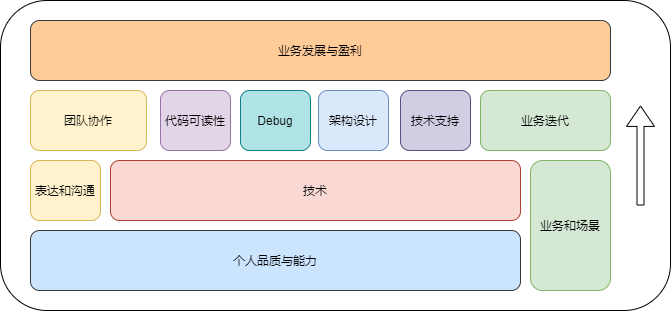
The structure has four levels, from bottom to top and inside to outside, from individual ability to collective profit. It explains the relationship between individuals and company profit through a hierarchy.
The lower level supports the upper level. If we understand the levels as a ring, the bottom is its core and the top its shell. The upper levels are also the knowledge and abilities we use most easily at work, as well as the results of our work.
For example, “personal qualities and abilities” at level one are abstract traits that support our entire development. “Expression and communication” and “technology” at level two are the individual abilities most often used at work. Each point at level three is a concrete ability that can be directly experienced. Level four is the result of our actions and our ultimate purpose.
3. Analysis
Level One
- Personal qualities and abilities mean latent ability and future value. They are difficult to make concrete and include learning ability, capacity for continuous development, and thinking ability. Your technical skills and other visible abilities are all acquired on the basis of these qualities. Every ability we display is centered on this level. It is also tested in interviews. For example, interviewers often ask, “What are you reading recently?” They want to assess your ability to learn and your passion for technology.
Level Two
- Technology means technology in the broad sense, with an emphasis on fundamentals: computer networks, operating systems, language proficiency, architectural thinking, and so on. Many interview questions test this level. The cultivation of “dragon-slaying skills” depends on it.
- Expression and communication usually have no specific interview question. As the name suggests, the interviewer judges them through your entire conversation.
Level Three
- Teamwork is based on communication and technology. It uses tools such as Git and is assessed by HR and technical interviewers.
- Code readability is difficult to assess in an interview but helps greatly in daily work. See Refactoring: Improving the Design of Existing Code, Alibaba Java Coding Guidelines, and Effective Java.
- Technical support is broad: understanding and wrapping middleware, developing a middleware system or plugin, mastering new language features, or applying performance-improving practices. These are used less often, but when they are used they are certainly worth celebrating as a KPI.
- Architecture design ranges from high availability, high performance, and scalability to the design of each business iteration.
- Business iteration means combining business understanding with code that better meets business needs, empowers the business, and drives its development.
4. Answers
- Why must interviews build airplanes? Internet-industry competition and increasing applicant numbers have pushed questions farther afield and made them harder to distinguish candidates. Interviewers also want to assess core ability. In the diagram, this is the “technology” module of level two: current value and future value.
- What screws are tightened in real work? “Tightening screws” is a metaphor for work that lacks challenge or is repetitive and simple. Teamwork, business understanding, and code readability are abilities almost everyone has, so they do not distinguish people much. Debugging is also treated as a trivial task without systematic measurement, while architecture and technical support are rare for junior programmers. This creates the illusion that everyone is only tightening screws. But if we work hard to do these things well, are we still merely tightening screws?
PS: When reporting to a manager, show both current and future value. Current value includes work completed and goals achieved; future value includes potential, learning ability, and other things that may create value for the business.
5. Tightening Screws Better
Interviews emphasize level two, while work and promotion emphasize level three. We should deliberately train level-three abilities at work, such as considering better designs during business iterations. Even without opportunities to design architecture, we can study and thoroughly understand the company’s existing architecture. Discovering shortcomings in the current stage and filling them in is also part of tightening screws.
We still need to strengthen level two. Fundamentals are not easily forgotten, but algorithms and interview trivia can always become rusty.
As we grow older, we should learn to abstract methodology from concrete scenarios and then expand that methodology back into concrete scenarios. During learning, we should build an iterative relationship of learning -> thinking -> borrowing -> using. Then the airplanes we build will not be useless.
6. Future Additions
This diagram has limits; it is mainly for junior programmers. For Alibaba social recruitment, a senior development engineer (P6) may also need previous business experience in the “personal ability” module. For social recruitment, individual and business should therefore be slightly coupled, which is why most job descriptions prefer relevant experience.
For a senior technical expert (P8), the business part needs adjustment. Above “business and scenarios” there may be “innovative business.” Code readability takes a smaller share, while teamwork expands and team management is added.
I did not draw these because the diagram is for newcomers like me, and I have not experienced those roles, so I do not dare make careless judgments.
Finally, a small advertisement: welcome to follow my public account, “王星星的魔灯.” Referrals and interviews await~